Andrew's Blog
Andrew's Blog


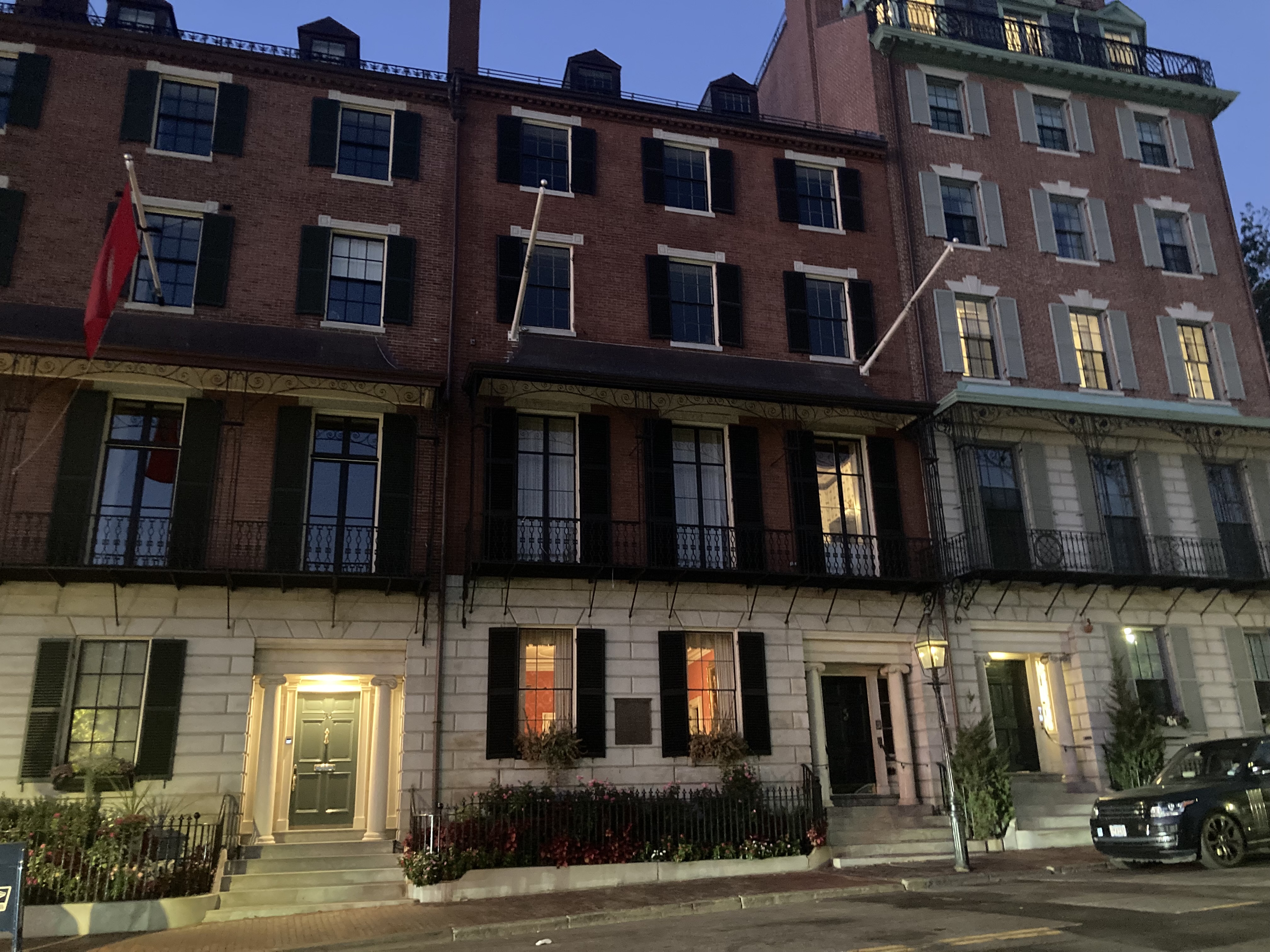
For October we are celebrating the Halloween season by recounting ghost stories. I didn't finish this in October though... Luckily, the ghost story I picked took place right around Thanksgiving in 1849. So it can be a November story too.
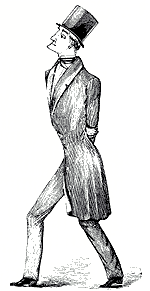
Boston, having a long history, naturally has lots of haunted places. This month I want to talk about one of its most high profile murders. The murder of George Parkman. We begin by identifying our three main players: a flâneur, a doctor, and a Swamp Yankee.
George Parkman was born February 19th, 1790 into a wealthy Boston family. The Parkmans were members of the "Boston Brahmins." I haven't talked about the Boston Brahmins in previous blogs but they have come up in my research. Especially while learning about Mount Auburn Cemetery last month. Many of the most grandiose tombs were from members of this caste. The name comes from Hindu Brahmin, the highest caste in the Hindu Caste system. The elite, old money of Boston in the 19th century took on this moniker. Most of them descendants from original English settlers in New England that had time to acquire land and build the systems that shaped the state. If you read history of Boston in that century you will undoubtedly come across that term. Now you know what it means.
The Parkmans were one of these families. They owned much land in Boston's West End. They also owned two towns, both named Parkman, one in Maine and one in Ohio. Through marriage the Parkman's had connections to many Beacon Hill families in Boston as well. Converting his 1849 wealth to the present day, George Parkman would be worth around 20 million dollars today.
George Parkman's primary job, as owner of so much, was to collect rents. Every day he would walk the streets of Boston, greeting people and collecting money. Fanny Longfellow, wife of the poet Henry Wadsworth Longfellow, called him "the good-natured Don-Quixote." Boston newspapers often referred to him as "The Pedestrian". His walking about town is much like the original flâneurs of Paris. He was well known around town for being generous with loans but strict on collecting what was owed.
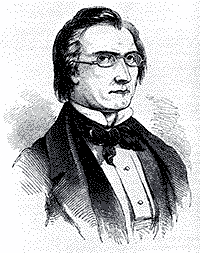
John Webster was a lecturer and researcher at the Harvard Medical School. Colleagues mentioned his classes could be quite difficult and focused on modern (at the time) chemistry discoveries. Other professors said that Webster had a penchant to use pyrotechnic demonstrations.
Webster, like Parkman, was also from a Boston Brahmin family. But, unlike Parkman, he faced financial troubles. In 1849, the Webster family had to sell their Cambridge mansion. The lecturer's salary wasn't covering what he spent. Webster was in debt to many of his friends, including Mr. Parkman.
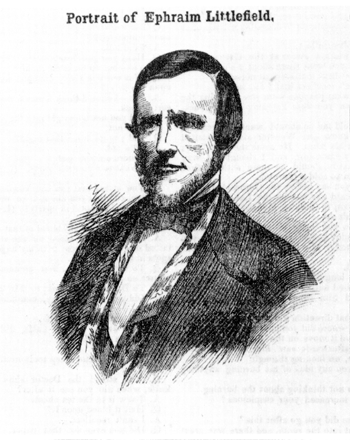
The opposite of the Boston Brahmins, the term Swamp Yankee also refers to descendents of the early English colonists. However, these folks were often more rural, less educated, and less refined. Swamp Yankee did not have the same connotation of wealth that the Boston Brahmin title carried. Ephraim Littlefield, was a member of this lower class.
Littlefield worked as a janitor at Harvard Medical school and lived with his wife in the basement of the building adjacent to Webster's lab. He often observed the professors at work, especially for anatomy lectures and dissections. He had the unpleasant job of setting up and cleaning up after this work. But he at least got along well with the staff.
One November day, a week before Thanksgiving 1849, George Parkman was making his rounds. George Parkman had been trying for some time to find John Webster so he could collect on his debts. His search was in vain until Webster showed up on his doorstep early the next day. He invited Parkman to come to the medical college at Harvard later that afternoon to settle the debts. Around 1:30pm on November 23rd, Parkman left his house and it was the last known sighting of the man.
At 6:00 PM, Webster was seen at a friend's house for a party. Our swamp yankee janitor, Ephraim Littlefield was unable to clean Webster's lab that day as it had been locked from the inside.
Over the next several days, the Parkman family began a search for George. George's brother, Reverend Francis Parkman, ran into Webster over the weekend. Webster, possibly trying to be helpful with the search, told the Reverend that he had seen George on 23rd and had paid him a $483.64 debt installment. He said Parkman had been heading toward the city clerk to record the debt payment.
By Monday the 26th, the family was no closer to finding Parkman. A $3000 reward for finding him alive or a $1000 reward for finding his body had been posted. The Boston Police had the Charles River and Boston Harbor dragged to search for the body. Search parties were working day and night. They searched through all of the rental properties Parkman owned. With his last known sighting on the way to Harvard Medical, they searched the school. They focused on labs and dissecting vaults but there was no sign of Parkman. Not even evidence that he had ever been there.
Littlefield reportedly felt increasingly nervous around this time. The police were investigating the place he worked, he was not as well respected as the Harvard faculty, and gossip was starting to float the idea that he was responsible for the disappearance. Salacious rumors were spreading around town in general. Unrelated to Littlefield, some less than reputable news sources were doing the same thing they do today, blaming immigrants. In the mid 19th century, this focus was on the Irish. As the search went on tensions in the Boston area were growing.
Littlefield and Webster had a strange encounter in the Harvard building after one of the police searches concluded. Webster asked Littlefield many direct questions about if he had seen Parkman in the building around 1:30 on the afternoon of the 23rd. Littlefield said no. Webster repeated his story about paying off debts. This was the most words the two had ever shared while working at Harvard. Webster sent Littlefield a turkey for Thanksgiving the next day.
All this made Littlefield suspicious.
On Wednesday November 8th, Littlefield spied on Webster. He saw him go back and forth between the fuel room and furnace of his lab eight times. The furnace burned hotter than it ever had before. The wall in the adjoining room was hot to touch. The next day was Thanksgiving, in the empty Harvard halls Littlefield got to work trying to chisel a tunnel through the bathroom into Webster's lab. The police had not searched the latrine. Littlefield made good progress but decided to go to a party...
...He did come back the next day though! As his excavation continued he began to find bones.
With this discovery he rushed to another Harvard professor, Jacob Bigelow. Bigelow went to get the police Marshal, Francis Tukey. By the time the police had arrived the word had spread and quite a crowd had formed.
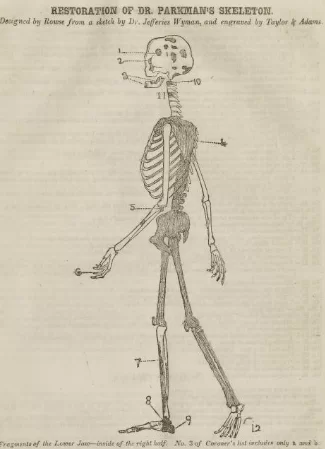
More bones were found in the lab's private bathroom. Bone was found fused to the sides of the furnace. Attempts to clean blood stains were spotted around the room (although the supposed chemical used for the cleaning was copper nitrate, which also can be used to make fire fun colors so maybe it was just Webster's pyrotechnic lecture). Torn pieces of Parkman's clothing turned up. A reassembly of the bones revealed the skeleton to match in height to Mr. Parkman. It seemed like the search was complete, albeit not the outcome anyone was hoping for. The police, led by Marshal Tukey, brought Webster to jail. Webster cursed them and stated it must be the janitor, only the two of them had access to the private bathroom.
Webster sat in jail for some time before being indicted of murder in in January. The energy of the town was not satisfied. Many of the elite were happy Parkman's body had been found but were in disbelief that a member of their Boston Brahmins could be the culprit. Many still believed Littlefield was responsible. Henry Wadsworth Longfellow's wife, Fanny Longfellow, the same woman who gave Parkman his flâneuring title, wrote "Boston is at this moment in sad suspense about the fate of poor Dr. Parkman. ... You will see by the papers what dark horror overshadows us like an eclipse. Of course, we cannot believe Dr. Webster guilty, bad as the evidence looks. ... Many suspect the janitor, who is known to be a bad man and to have wished for the reward offered for Dr. Parkman's body. He could make things appear against the doctor, having bodies under his control."
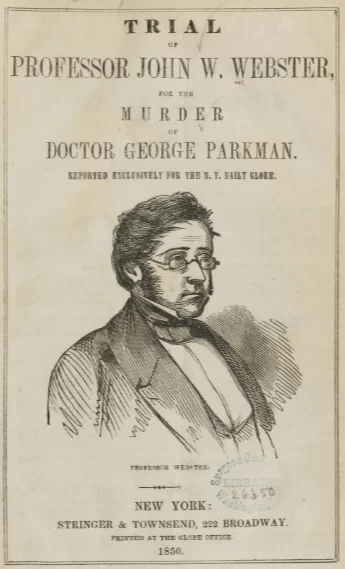
While awaiting trial, Webster wrote a 194 page defense for himself. The trial was a bit of a mess. It became a spectacle, thousands gathered in the streets to try to catch a glimpse. International news picked up the story, articles appeared in Paris, London, and Berlin newspapers. The judge, Lemuel Shaw, was close friends with the Parkmans and seemed to be predisposed to believe Webster was guilty. Opportunists began selling tickets to the crowd to get a look. Estimates say nearly 60,000 people attended the court room as spectators. It was an event.
Despite the spectacle the trial became, it did have important precedent for American case law. Analysis of the skeleton was a key factor in proving the body in Webster's lab belonged to Parkman. Most importantly, this was the first court case in the U.S. to use scientific testimony regarding dental records as evidence in court. One of the bones found in Webster's furnace was a jaw bone containing false teeth. Parkman's dentist testified that these teeth belonged to George Parkman.
The trial was not going well for Webster. The 5th amendment to the U.S. Constitution gives people a right to remain silent and avoid incriminating themselves. But prior to the 1860s, 1866 specifically for Massachusetts, it wasn't just a right it was a requirement. Inheriting some parts of English law, defendants were completely banned from taking the stand in their own defense. Individual states began to override this in the mid 19th century in the U.S., starting with Maine. Webster, was not a fan of this rule and against his defense attorney's advice he became an early advocate for taking the stand himself. He gave a 15 minute speech at the end of the trial in which he pleaded his innocence and contradicted the story the defense presented.
The jury found Webster guilty and he was sentenced to be hanged.
Much push back followed. Webster's lawyers attempted to petition a writ of error against the bias of Judge Shaw. Webster and members of the Boston Brahmins wrote letters to Massachusetts Governor George N. Briggs demanding clemency, but the requests were denied. Webster, in a final attempt at survival, wrote a letter confessing to the crime but claiming it was self-defense. Renewed pleas for dropping the sentence were sent out.
In August 1950, John Webster was hanged.
Or was he? Officially and most likely yes. But 34 years later, a Boston Globe article speculated the hanging may have been faked by the wealthy of the town. The theory went that Webster was placed in a harness so the hanging did not kill him. Witnesses remember the body being moved from the gallows to a neighboring house but not seeing it taken to the graveyard. One sailor reported seeing Webster in the Azores many years later. No dental or skeleton evidence has been done on his body.
We have one last character, what happened to Ephraim Littlefield? His discovery of the bones is what the whole trial hinged upon yet many of the Boston Brahmin class said that he must have been the true murderer. Well, he received his reward for finding Parkman. Although George was not found alive, the family still paid Littlefield the full $3000 prize, roughly $130,000 today. Which was enough for Littlefield and his wife to comfortably retire and be out of the public eye for the rest of their days.
So far this has been a true crime story. I promised a ghost story though.
Parkman was murdered in Harvard Medical School. At the time this was near the present day Mass General Hospital between Boston's West End and Beacon Hill. However, the school moved in 1883 and 1906. The original Parkman house in Beacon Hill still stands today. Somewhere between 1849 and the 1906 move Parkman's restless spirit was freed from Harvard and returned to its original home.
Visitors and tour guides of the historic site report "eerie footsteps, flickering lights, and an unsettling presence that sends chills down their spine."
Most spookily, we know Parkman's bones were discovered in a latrine. Since the house's haunting, the Parkman House bathroom has flooded several times. Most recently in 1999. Scholars of the paranormal believe the flooding toilets are a sign of Parkman's spectral presence. Coincidence or a message from the beyond?
I hope you enjoyed this "spooky" tale. It seems a lot of Boston's scary stories all tie back to old trials and spectacle, like the witch trials. There haven't been ghosts here in a long time since technology and court cases became better. Coincidence or another ghostly message? You can decide.
Subscribe to the RSS Feed to see more flâneur content!